
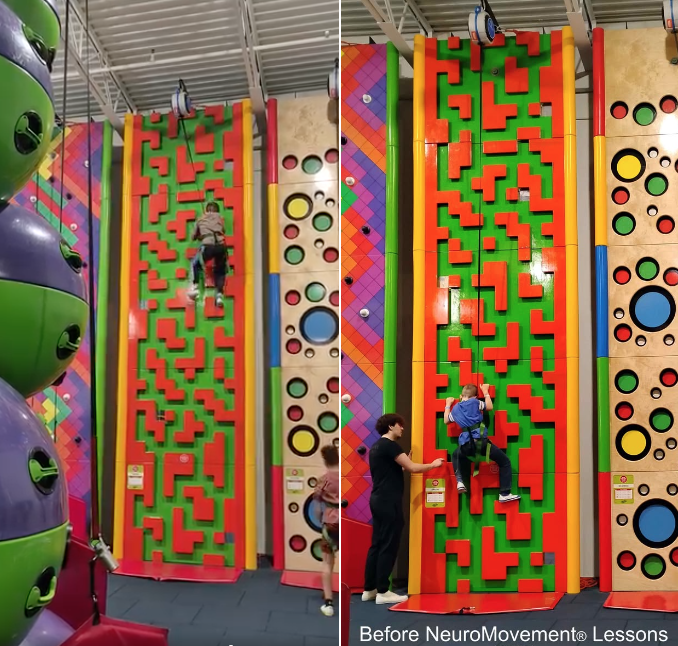
Results from 9 NeuroMovement lessons over a 8 month period
Presentation: In November 2025 the child presented with balance issues and sore hips, and experienced frustration doing sports. He was diagnosed at the time with inattentive ADHD, and his mother reported he had a retained fetal reflex. His mother also reported that he was home schooled and sometimes struggled to join in outgoing activities with other children and also presented with self-stimulatory behavior at times and the inability to alternate stepping from left to right on stairs. He is presently being accessed for ASD.
November 2025 to present progress summary:
He has had 9 NeuroMovement lessons since Nov 2025 lasting roughly 45 minutes to 1 hour each lesson.
During the first lesson, I noted that the ability to arch the lower back was not clear. Neither was a sense of using the pelvis to power actions. I also noted persistent muscular contractions in his arms, legs and torso. I observed that he spoke with a monotone voice.
Through a series of lessons based around functional movement such as arching back the back with participation and differentiation in the upper torso, as well as rolling, reaching, side bending, diagonally reaching heels on belly and organizing belly crawling. These movements increased proprioception and helped to fill in deficits to better bear weight through the skeleton and sense gravity in his actions that initially required more muscular effort. We also engaged in movements that required slowing down, and using less force, and also combining a variety of ways to move. During the lessons, I engaged him in conversations that would require imagination and critical thinking. One of the main components of NeuroMovement is the ability to perceive a difference by providing the ideal conditions for the brain to change. He excelled at these lessons and began to form action with more ease and comfort, and I saw an increased comfort in using his imagination to form thought.
Outcome:
This child is a highly intelligent boy who initially didn’t have well formed patterns of movement. During the lessons to present, he has gained more balance and stability, he is now able to climb a rock wall using his spine effectively, with the relationship with the head and pelvis better formed in his awareness. The overuse of his hip joints has resolved with no more pain, his voice is starting to shift pitch slightly. His social skills have improved – he recently participated in a theatre performance. His mother noted that his retained fetal reflex has resolved since participating in NeuroMovement lessons.
Goals and Plan forward:
I recommend that he continue NeuroMovement lessons at least once a month to further develop resilient movement patterns and support both physical function and emotional regulation. I also recommend Sound Therapy using filtered music to support auditory processing and neurodifferentiation by gradually increasing exposure to higher-frequency sounds.